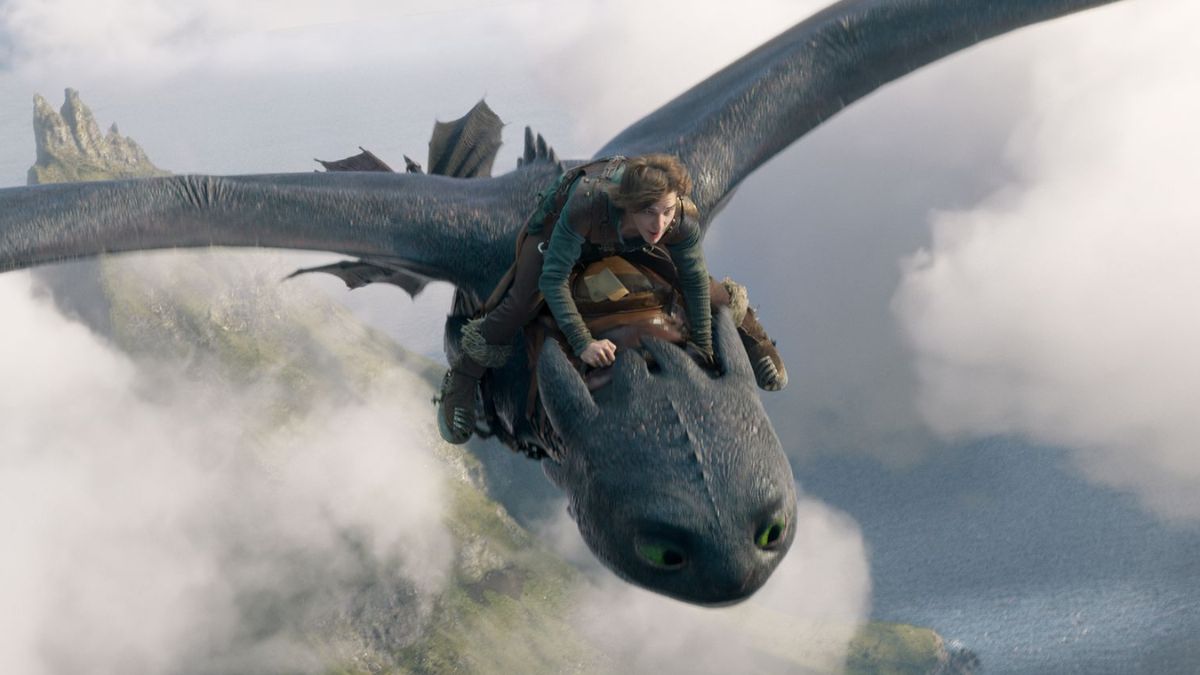
When a story hinges on trust, you can’t fake the payoff. That’s why the first true flight between Hiccup and Toothless—the sequence fans often think of as the franchise’s emotional “lift-off”—was always going to be the make-or-break moment for the live-action reimagining of How to Train Your Dragon.
Writer-director Dean DeBlois, who also helped shape the original animated trilogy, told Entertainment Weekly that seeing the flight scene finally come together surpassed what he’d hoped for. After all the testing, tweaking, and engineering, he said the finished sequence “did not disappoint,” adding: “I was squealing inside.”
Why this one scene matters so much
The flight isn’t just a spectacle beat. It’s the moment the movie proves its central relationship is real: a boy and a dragon moving as one—fear turning into exhilaration, and suspicion turning into partnership. DeBlois described the intention clearly: Hiccup shouldn’t look like a passenger stuck on top of a digital creature. He should look like a rider genuinely synced to an animal’s body language.
That “earned” feeling is also why the scene is typically paired with John Powell’s returning score, which DeBlois and the production leaned on as a kind of emotional throughline between versions of the story.
Step one was getting Toothless right (and not overcorrecting)
Before anyone could “fly,” the team had to solve Toothless in live action: believable enough to stand next to real actors and physical sets, but still expressive enough to feel like Toothless. The challenge, as DeBlois explained, was that every push toward realism risked sanding off the character.
In the EW breakdown, DeBlois said early experiments shrinking Toothless’ signature oversized features cost the character’s presence—so the team clawed back the essentials: the broad mouth, ear plates, and big eyes, then built credible anatomy and skin detail around that stylized core.
The Los Angeles Times framed the same priority as preserving Toothless’ “sentience and personality,” much of which reads through the face—those large eyes and distinctive features that connect back to the animated design.
On the VFX side, realism wasn’t just a texture pass—it was movement. A major anchor reference for Toothless’ physicality was a black panther, used to guide how the dragon leaps, lands, and carries weight.
Making “flight” feel physical (not like green-screen acting)
Here’s where the production got brutally practical.
A massive motion rig, plus an animatronic body
To avoid the common problem of actors bobbing around on a static saddle, DeBlois said the team built a large mechanical gimbal system—roughly eight to ten feet tall—that could move in multiple axes to match banking, climbing, and rolling.
Then they layered in something even more important for performance: an animatronic dragon body/neck/head with a saddle and physical handholds, so Mason Thames (Hiccup) was reacting to real motion cues rather than pretending against thin air. DeBlois emphasized the goal: Hiccup and Toothless should look “symbiotic,” like true partners in the air.
Previs precision and controlled environments
For the actual flight shots, DeBlois said the production used indoor blue-screen setups, guided by detailed previsualization so the camera language and rider movement were mapped before filming.
Sequences involving water were shot in an underwater tank at Pinewood Studios, according to DeBlois’ EW interview.
Music on set (because otherwise it’s just hair dryers and blue walls)
Thames put it in blunt, relatable terms: for the flight sequence he was essentially on a gimbal with blue screens and wind blasting his face. The fix was smart: play the score while filming.
In EW, Thames said it was his mom’s idea to have Powell’s music playing during the shoot, and that it “helped tremendously.”
Reuters reported a similar detail from Thames, describing the setup as being like a “giant mechanical bull” with wind machines—and the music playing to help him hit the right emotional and physical energy.
The world around them had to feel real too
The flying scene may be effects-heavy, but DeBlois repeatedly pointed to physical craftsmanship as the foundation—especially for everything on the ground in Berk.
In EW, he said the bulk of the movie was shot in and around Belfast, including Titanic Studios, a site associated with Game of Thrones—and he joked that when they arrived, “King’s Landing was still standing in the back lot.”
In a separate interview with The Credits, DeBlois described scouting dramatic coastal locations (including Iceland and the Faroe Islands) to shape the grounded scale of Berk, and praised the local crew talent—explicitly noting they drew heavily from the Game of Thrones workforce for building and detail work on the sets.
The takeaway: the scene works because it’s built like a stunt, not a shortcut
DeBlois’ “I was squealing inside” line isn’t just cute. It’s basically the reaction of a director who knows the audience will sniff out anything weightless.
This flight sequence lands because it’s engineered to give actors something real to ride, shot with a plan (previs), anchored in believable creature movement, and emotionally timed to a score that already carries deep franchise memory.