When KPop Demon Hunters landed on Netflix in June 2025, it arrived looking like a purpose-built mashup: a glossy K-pop trio, high-energy musical numbers, and supernatural action rooted in Korean folklore. But co-director and co-writer Maggie Kang says the movie didn’t begin as a K-pop story at all.
Speaking at the 2025 Busan International Film Festival, Kang described the earliest version as a more straightforward fantasy idea built around Korean mythology and “a group of really incredible women who fight demons.”
The concept, she said, needed another dimension—something bigger that could expand the spectacle and the scale. That’s when K-pop entered the picture, transforming the project into a full-blown musical with a “day job” that could be both culturally specific and globally legible.
That creative pivot is now inseparable from the movie’s identity. KPop Demon Hunters follows Huntr/x—Rumi, Mira, and Zoey—who perform as a world-famous girl group while secretly battling demons and reinforcing a spiritual shield known as the Honmoon.
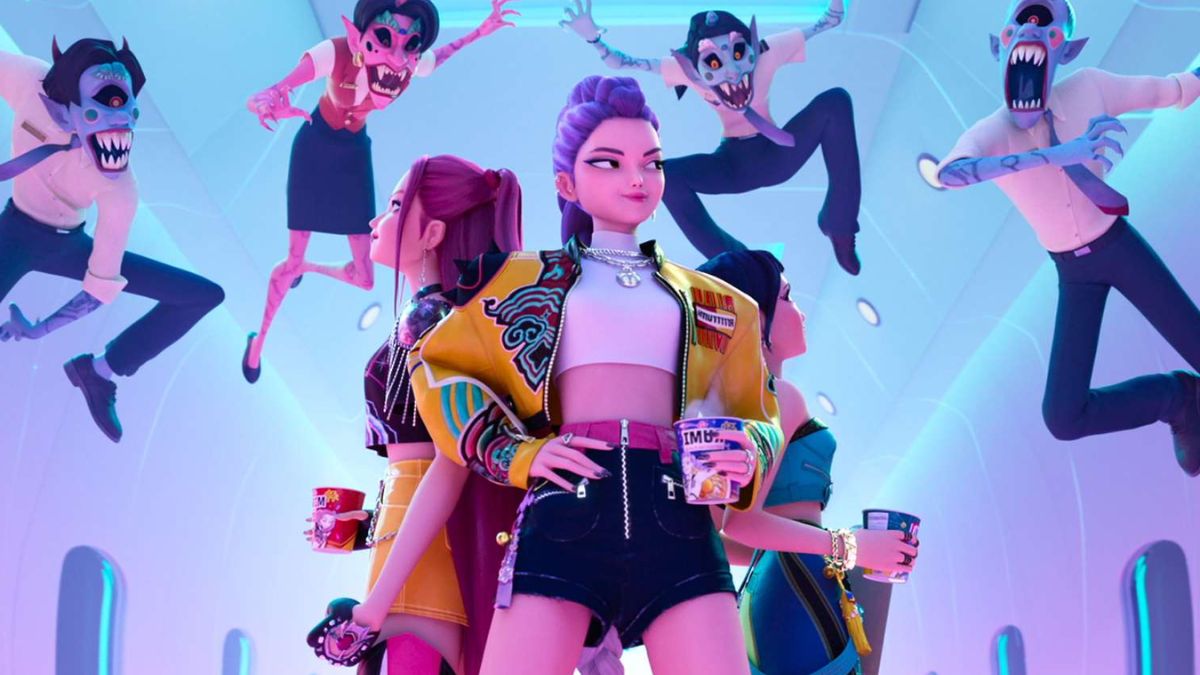
Kang has linked that “music as protection” idea to Korean shamanic traditions, pointing to the mudang (Korean shamanism) and the use of song and ritual to ward off evil—an influence that helped the film’s pop spectacle feel connected to something older and more culturally grounded.
The result, by most measurable standards, is a breakout. TIME reports the film surpassed 325 million views in its first three months and became Netflix’s most-watched original film to date, with a soundtrack that also exploded on the charts.
That kind of success is exactly what triggers franchise questions in today’s IP-hungry entertainment economy—and Kang has been careful about how she answers them.
On the one hand, she’s openly acknowledged there’s more story to tell. In an interview referenced by the Los Angeles Times, Kang said she believes there’s “definitely more we can do with these characters in this world,” while also stressing that any follow-up should be a sequel that earns its existence—something the team genuinely wants to see, not a sequel-by-default.
She and co-director Chris Appelhans have also pushed back on the idea of a live-action remake, arguing that the heightened tone and physicality of the characters are part of what animation does best—and could feel awkwardly “grounded” in live action.
At the same time, Kang has teased what “more” could actually look like if it happens. In an August 2025 press conference in Seoul, she suggested a sequel could broaden the musical palette beyond mainstream K-pop—name-checking everything from trot to heavy metal—and dig deeper into character backstories that the first film only had time to sketch.
That aligns with what viewers often latch onto in the film: the sense that the world has history (and secrets) beyond what the first instalment fully reveals.
Cast and collaborators are thinking along similar lines. In an Associated Press profile, lead voice actor Arden Cho (Rumi) expressed hope for sequels and even prequels, specifically pointing to unanswered questions about Rumi’s family history and the origins of Huntr/x as a team.
As for what’s next in a practical sense, some reporting has pointed toward a long runway typical of big-budget animation. TIME notes that sequel reports surfaced amid the movie’s awards-season momentum, and AP’s profile also mentions a sequel being “slated” for 2029—though, as with most projects this far out, plans can shift with development realities.
In a way, the franchise conversation circles back to the same creative logic that made the first film work: KPop Demon Hunters got bigger when the story found the right “something else.”
Kang’s comments suggest she’s applying that same standard to any continuation—if a sequel happens, it won’t just be “more Huntr/x.” It’ll need a new angle, a fresh musical or mythological idea, and a story that justifies returning to this world rather than simply extending it.