Brady Corbet’s The Brutalist doesn’t so much “wrap up” as it reframes itself in the final minutes, closing with two deliberately disorienting sequences: one that punctures the movie’s midcentury story on a note of rupture, and another that jumps forward decades to recast the meaning of the work at its center.
The first of those final beats lands in the late 1950s, when Erzsébet Tóth (Felicity Jones) confronts industrialist Harrison Lee Van Buren (Guy Pearce) in front of his dinner guests and accuses him of a serious act of abuse against her husband, architect László Tóth (Adrien Brody).
Van Buren denies it in the moment, though the film has already shown the accusation to be true — and the scene ends with a further chill, as Van Buren slips away and then vanishes entirely from the story’s present tense.
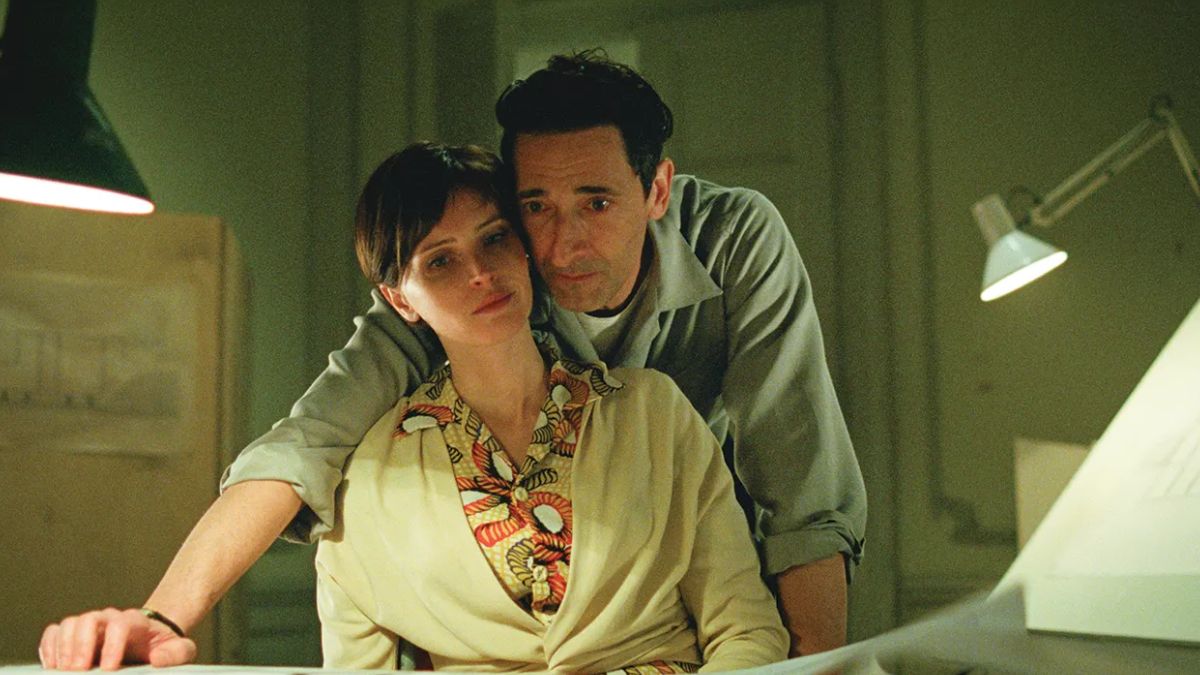
Then Corbet jumps to the 1980s for an epilogue set at the Venice Architecture Biennale, where an older László — visibly diminished and largely unable to speak — is honored with a retrospective. His niece Zsófia (played in the epilogue by Ariane Labed) takes the podium in his place, delivering the speech that has fueled most of the film’s post-screening debates.
In her remarks, Zsófia asserts that László’s monumental building is modeled on a structure that once imprisoned him in a Nazi concentration camp, with one crucial alteration: soaring, extended ceilings. She closes with a pointed line — “It is the destination, not the journey” — that can read like a thesis statement, a provocation, or both.
Corbet’s own explanation leans into that both/and tension. Asked whether Zsófia’s account is meant to be taken as definitive truth or personal interpretation, he says it’s “both,” arguing that public art (architecture included) can’t have a single “right” reading — and that over-explaining would drain the film of its conversational “magic.”
Brody, meanwhile, has suggested the epilogue’s symbolism is meant to land emotionally even if viewers don’t treat every detail as literal biography, pointing to the ceiling height as key to the building’s spiritual aspiration — a visual reach toward “reprieve” and inspiration “from above.”
That mix of conviction and ambiguity is part of why the epilogue has proven so combustible. Even outside film circles, it’s sparked argument — including in the architecture world, where critics have taken issue with how the movie positions brutalism and how it uses the 1980 Venice Biennale as a framing device.
But within the film’s logic, the epilogue functions like a final architectural detail: it changes the way you read the structure you’ve been watching built, shifting the story from patronage and survival toward legacy, authorship, and who gets to narrate an artist’s pain.
And, as Corbet notes, if you’re looking for a clearer “answer,” the movie itself may have already offered one earlier — in László’s dialogue about trauma and its cycles — and then simply asked you to carry it into that last, haunting jump forward.